Luxury Watch Materials Guide: Steel vs Titanium vs Ceramic vs Gold — Which Is Best?
Compare six popular watch materials by weight, scratches, impact behavior, comfort, appearance and maintenance—then choose what fits your lifestyle.
Introduction: Which Luxury Watch Material Is Best?
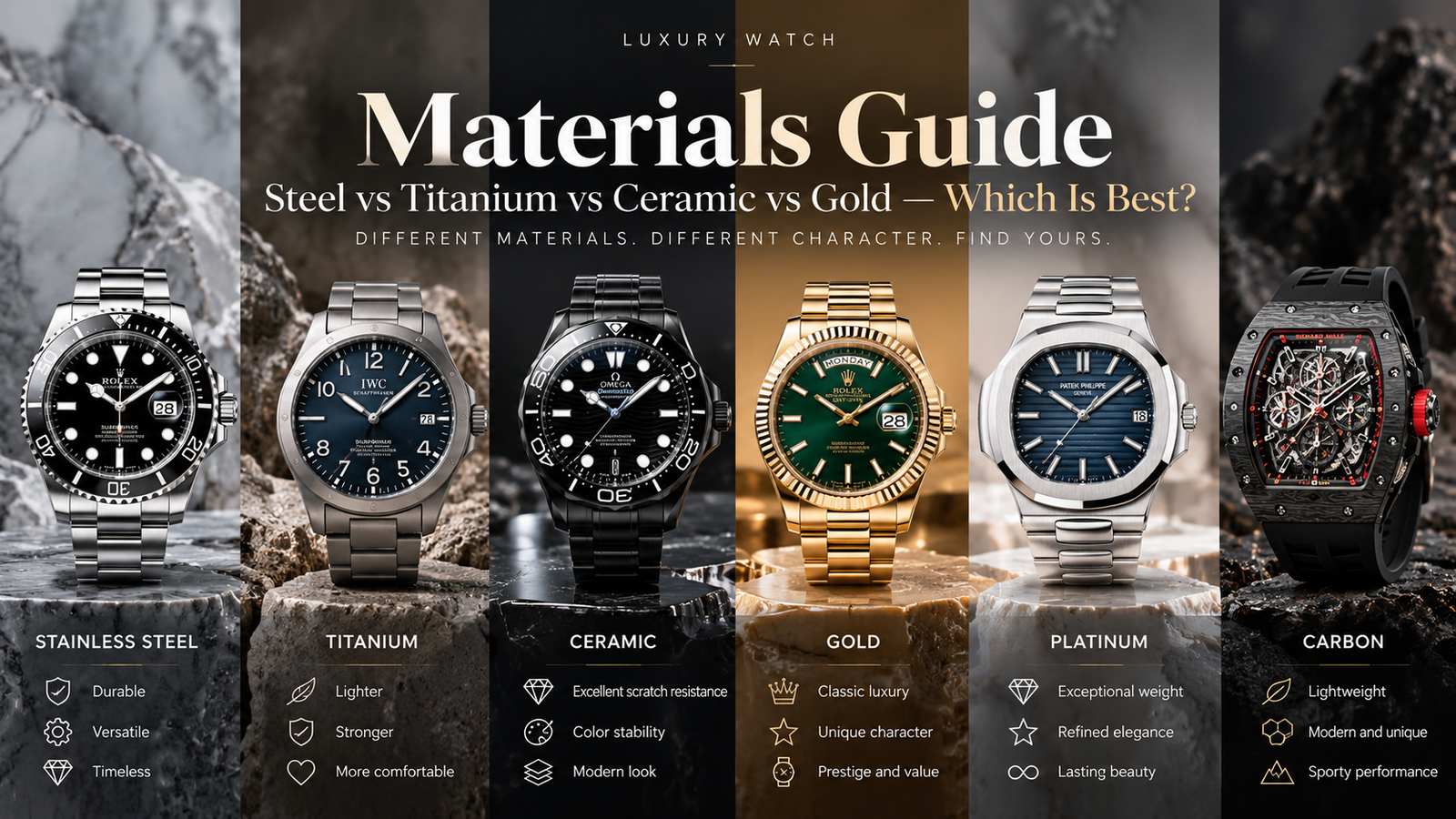
The best material depends on what matters most to you. Stainless steel offers balanced everyday usability, titanium reduces weight, ceramic resists many surface scratches, gold adds warmth, platinum delivers noticeable heft, and carbon composites emphasize modern lightness.
This luxury watch materials guide helps you compare the real ownership trade-offs instead of choosing by photographs alone. Before buying, use our How to Choose a Luxury Watch article for a broader buying checklist.
Quick recommendation: Steel for versatility; titanium for lightweight comfort; ceramic for scratch resistance; gold for traditional luxury; platinum for heft; carbon for technical sport styling.
Why Watch Material Matters More Than Most Buyers Think
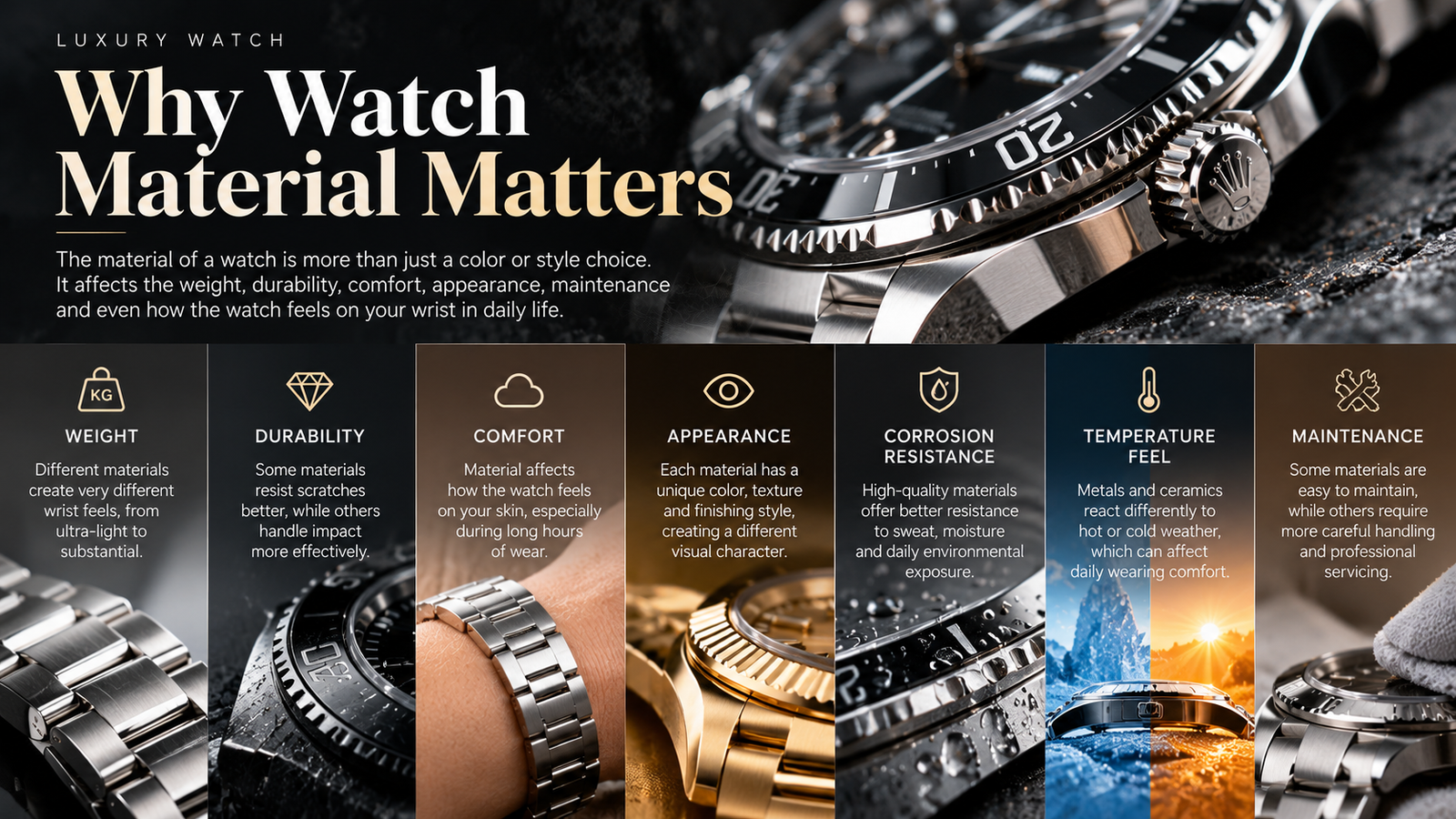
Material selection affects more than visual style. Weight and balance influence how much you notice a watch through a long day. Hardness influences visible scratches, but toughness determines how a component responds to impact.
Corrosion resistance matters around moisture and sweat; finishing changes reflections and how easily scuffs show.
- Weight: The case, bracelet, clasp and movement all contribute.
- Surface marks: Polished steel and precious metals show different wear from ceramic.
- Comfort: Fit and strap matter alongside density and skin compatibility.
- Temperature: Metals and composites can feel different when first touching the skin.
- Long-term appearance: Patina, coating wear and refinishing options vary.
Stainless Steel: The Best All-Round Choice?
Stainless steel is a reliable starting point for most buyers: strong, corrosion-resistant when suitably specified and available in attractive brushed and polished finishes.
It is common in sports-watch cases and bracelets because it balances toughness, aesthetics and serviceability.
Advantages and Trade-Offs
- Pros: Versatile looks, good toughness, familiar repair and refinishing methods.
- Cons: Heavier than titanium and prone to visible hairline scratches on polished areas.
- Finish: Brushing may disguise some minor scuffs; high polishing reflects more light and often reveals more marks.
A stainless-steel Submariner-style sports watch illustrates the conventional metal sports-watch aesthetic.
For additional educational material about stainless-steel alloys and corrosion behavior, consult worldstainless .
Best for: Everyday wearers seeking familiar weight, durability and versatility.
Titanium: Lighter, More Comfortable, But Is It Better?
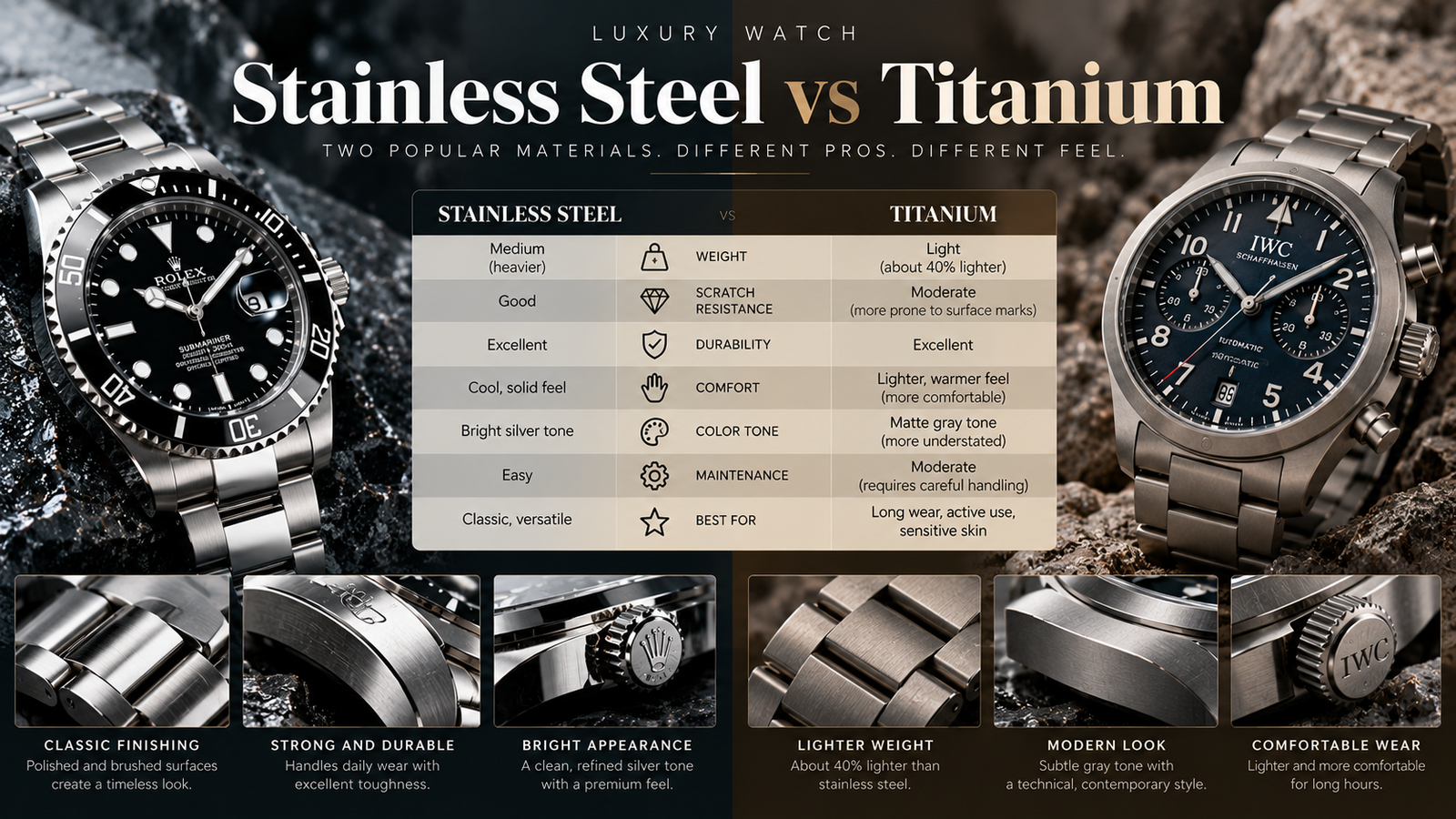
Titanium is much less dense than stainless steel: roughly 4.5 versus about 8 grams per cubic centimeter, depending on alloy.
Equivalent metal components can therefore weigh substantially less, though a complete watch includes other materials too.
Titanium commonly has a muted gray appearance and excellent corrosion resistance. It can be an appealing choice for people who wear a watch all day or prefer larger cases.
Some titanium finishes scratch readily; coatings and surface treatments can change that behavior. Do not assume that “titanium” automatically means scratchproof.
Stainless Steel vs Titanium Watch: Main Differences
- Weight: Titanium is significantly lighter for comparable metal components.
- Appearance: Steel usually has a brighter tone, while titanium often looks more muted.
- Comfort: Titanium can feel more comfortable during extended wear.
- Scratches: Surface treatment matters more than the material name alone.
- Maintenance: Specialized titanium finishes may need different refinishing techniques.
Best for: Long daily wear, lightweight sports watches and buyers who dislike heavy bracelets.
Ceramic: Scratch Resistance With a Different Trade-Off
Technical ceramic resists many everyday surface scratches and can maintain a stable color and polished appearance.
Watchmakers use it for bezels and, on some designs, cases or bracelet links.
Why Ceramic Is Popular
- Excellent resistance to many common scratches.
- Stable color under normal wearing conditions.
- Attractive polished or matte finishes.
- Strong corrosion resistance.
- Contemporary and distinctive styling.
Is Ceramic Durable?
Hardness is not the same as impact toughness. A strong blow near an edge may chip or crack a ceramic part even when a steel part would only dent.
A damaged ceramic component may require replacement rather than conventional metal polishing.
This is why ceramic watch durability should be evaluated in terms of both surface hardness and resistance to impact.
Best for: Careful wearers who prioritize scratch resistance and a smooth modern finish.
Carbon and Composite Materials: Lightweight and Modern
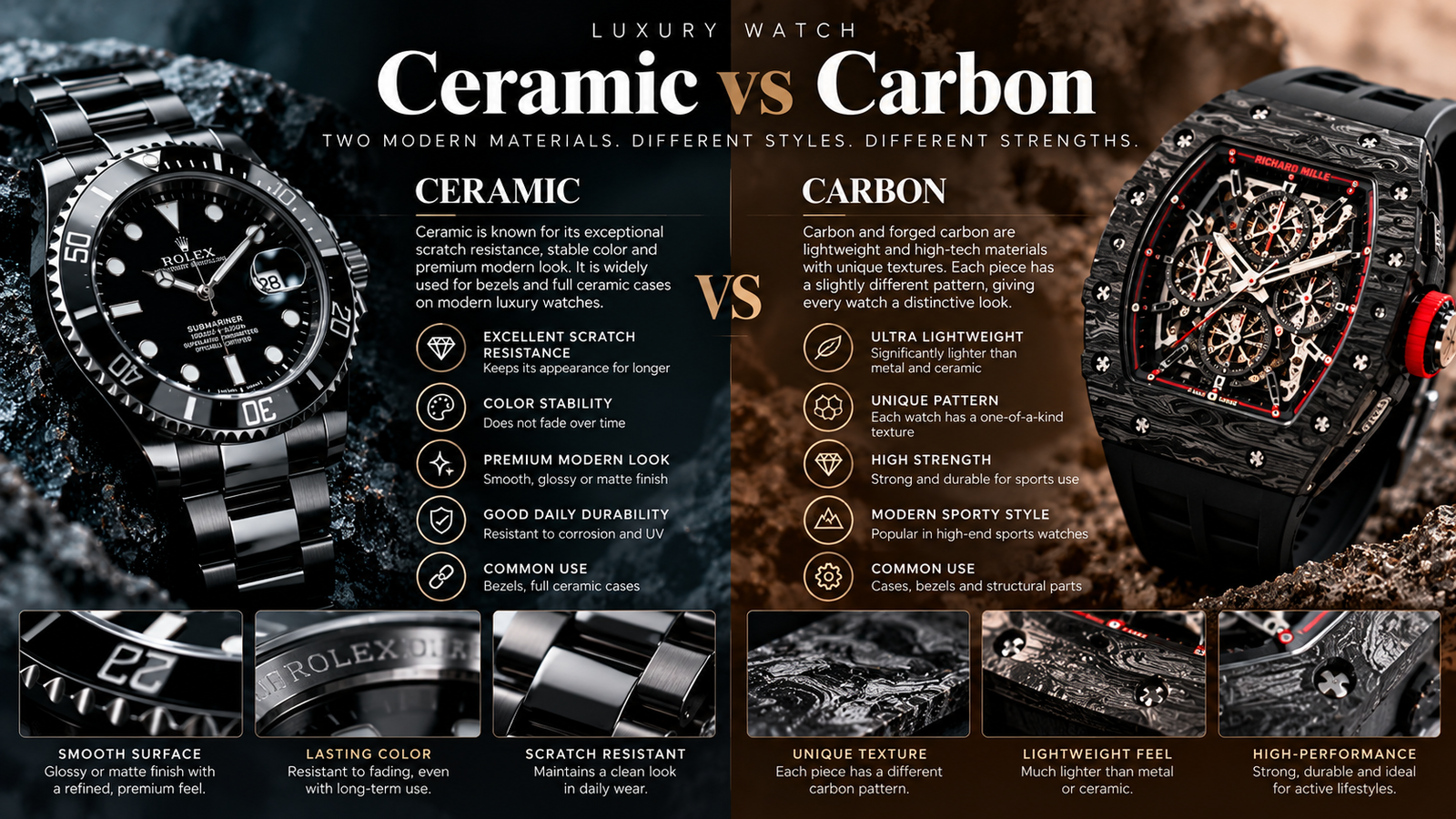
Forged-carbon and other fiber-reinforced composites can create ultra-lightweight case designs with striking patterns.
Fibers embedded in resin give a more technical appearance than a conventional metallic case. The visible texture may differ from one piece to another.
Forged Carbon vs Traditional Carbon Composites
Forged carbon can feature irregular, marbled surface patterns, while layered or woven carbon composites may display more directional fiber structures.
Performance depends on resin system, fiber orientation, manufacture and geometry.
Carbon composites are not automatically more impact- or scratch-resistant than steel. Different formulations behave differently, and deep damage can be difficult to restore.
Advantages of Carbon Watch Cases
- Very lightweight construction.
- Modern, technical appearance.
- Distinctive and sometimes unique patterns.
- Comfortable in many larger sports-watch designs.
Best for: Modern sports styles and buyers seeking low mass and unusual surface patterns.
Gold: Yellow Gold vs Rose Gold
Yellow gold offers a classic rich warm color, while rose gold gets its pink hue primarily from copper added to the alloy.
Many luxury watch components use 18-karat gold, meaning 75% gold by mass, but the precise alloy influences hardness and color.
Yellow Gold Watches
Yellow gold provides a traditional luxury appearance. Its warm color is recognizable and works well with many dial designs.
Rose Gold Watches
Rose gold offers a softer pinkish tone that creates a different visual character, particularly when paired with black, brown or neutral dials.
Solid Gold vs Gold Plating
Solid gold, gold plating, and gold-colored coatings are not interchangeable. Their underlying construction, weight, wear and value can differ dramatically.
Gold-alloy surfaces can develop small scratches and benefit from careful servicing; repeated polishing removes material.
Compare precious-metal-inspired aesthetics in the Daytona collection , and learn about gold color and purity at the World Gold Council .
Best for: Traditional luxury, warmer colors and dressier styling.
Platinum: Why It Feels Different From Gold
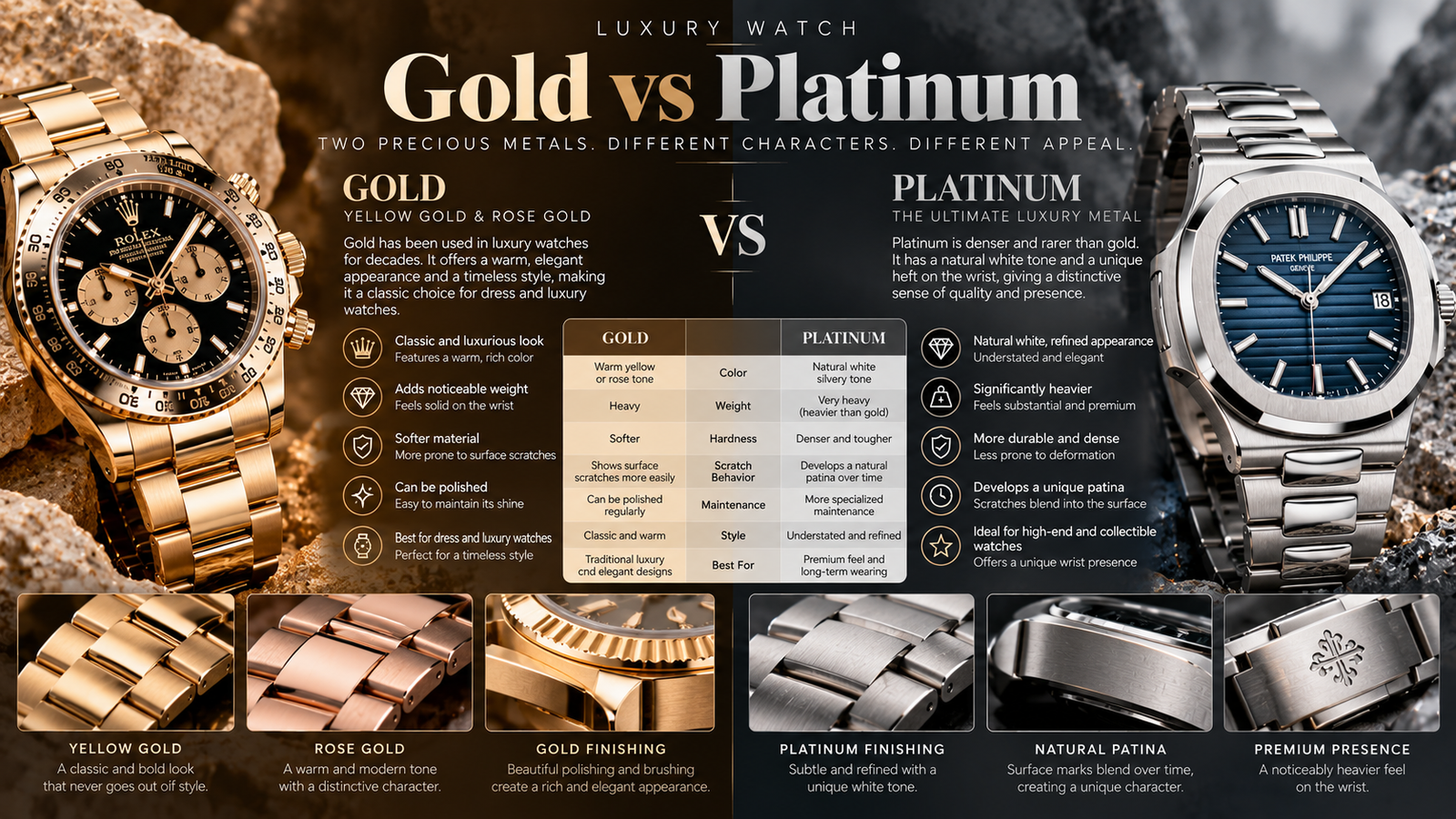
Platinum is dense and naturally pale, with a subtle luxury aesthetic.
Pure platinum is about 21.45 g/cm³ compared with about 19.3 g/cm³ for pure gold and roughly 8 g/cm³ for common steels; watch alloys have their own densities.
Why Is Platinum So Heavy?
A platinum case or bracelet can consequently feel very substantial. Compared with many steel watches, platinum offers a noticeably heavier wrist experience.
Platinum Patina and Maintenance
Fine contact marks may build a soft patina over time, and restoring a factory finish may require an experienced professional.
Buyers who appreciate heavy watches may find platinum particularly satisfying, while those who prioritize comfort might prefer a lighter material.
Best for: Buyers who value discreet precious-metal styling and significant heft.
Luxury Watch Materials Comparison Table
This luxury watch materials guide comparison is a broad buying reference, not a laboratory test. Specific grades, coatings, construction and wear conditions can change the results.
| Material | Weight | Scratch Resistance | Impact Behavior | Comfort | Maintenance | Best For |
|---|---|---|---|---|---|---|
| Stainless Steel | Medium | Medium | Generally tough | High | Conventional refinishing | Everyday wear |
| Titanium | Light | Finish-dependent | Generally tough | Very high | Finish-dependent | Long wear |
| Ceramic | Light–medium | Very high | Chip/fracture risk | High | Specialized | Scratch resistance |
| Gold | Heavy | Low–medium | Can dent/deform | Fit-dependent | Careful refinishing | Traditional luxury |
| Platinum | Very heavy | Alloy-dependent | Generally ductile | Weight-dependent | Specialized | Substantial feel |
| Carbon Composite | Very light | Construction-dependent | Construction-dependent | Very high | Specialized | Modern sports |
Remember: hardness, toughness, corrosion resistance and comfort are different properties.
Steel vs Titanium: Which Is Better for Daily Wear?
Choose Stainless Steel If…
You value a traditional metallic feel, polished-and-brushed contrast and familiar service options.
Choose Titanium If…
You prefer lighter weight, subdued color and improved comfort with a larger case.
The real deciding factors are the finished watch’s weight, fit and finishing—not the material name alone.
For everyday wear, stainless steel is an excellent general-purpose choice, while titanium is especially appealing when weight reduction matters.
Ceramic vs Steel: Which Handles Scratches Better?
Ceramic generally resists ordinary surface scratching better than untreated steel. Steel is typically more tolerant of knocks and easier to refinish after cosmetic damage.
Ceramic may remain glossy longer under gentle use, but sharp impacts pose a different risk.
Evaluate how you actually wear your watch: daily office use, outdoor activities and frequent contact with hard surfaces create different demands.
Gold vs Platinum: Which Feels More Premium?
Gold makes an immediate visual statement through yellow or rose color; platinum is more understated in color but can feel impressively heavy.
The better choice is personal. Also compare solid metals with gold-colored or platinum-colored finishes instead of treating appearance as proof of composition.
Gold is often preferred for its distinctive warm appearance, while platinum appeals to buyers who prefer substantial weight and discreet luxury styling.
Which Watch Material Is Best for Hot Weather?
Titanium and carbon composites can be attractive because of low weight.
Yet hot-weather comfort also depends on bracelet ventilation, skin contact, sweat, micro-adjustment and how tightly the watch fits.
Stainless steel can work very well with an adjustable bracelet; a suitable strap can matter more than the case metal.
For frequent outdoor wear in warm conditions, consider the combination of watch weight, strap material and comfortable wrist fit.
Which Material Is Best for Sensitive Skin?
Titanium may be suitable for people sensitive to some metallic alloys.
Ceramic surfaces contain no metallic nickel, though buckles, casebacks and hardware can still be metallic.
Stainless steel varies by grade and nickel release.
If you have a diagnosed metal allergy, verify exact components rather than relying on generic labels.
Which Material Is Best for Sports Watches?
For sports use, titanium and carbon can reduce mass, while stainless steel offers a tough traditional case construction.
Ceramic often works well for scratch-resistant bezel details but is not immune to hard knocks.
None of these materials independently guarantees water resistance or sports suitability.
For design examples, browse the GMT-Master II collection and compare bracelet and case configurations, not just surface colors.
How Watch Material Changes Size and Wrist Feel
Two watches can share a 40 mm diameter yet feel different due to density, bracelet links, thickness and balance.
Dense precious metals create wrist presence; lighter titanium or carbon may make larger cases more wearable.
Lug-to-lug length and bracelet adjustment remain important.
Related article: Luxury Watch Size Guide — Choose the Right Watch for Your Wrist explains case diameter, thickness, lug-to-lug distance and fit.
What to Check During QC for Different Materials
Material quality cannot always be judged from photographs alone. A careful watch quality-control inspection should consider construction, finishing, surface condition and material information.
Stainless Steel QC
- Check hairline scratches and surface marks.
- Inspect brushing direction and consistency.
- Examine polished-to-brushed transitions.
- Check sharp edges and bracelet finishing.
Titanium QC
- Inspect inconsistent surface color.
- Check coatings and visible finishing defects.
- Examine case and bracelet edges.
- Inspect the clasp and bracelet connections.
Ceramic QC
- Look for edge chips.
- Inspect for hairline cracks.
- Check bezel alignment.
- Inspect ceramic-to-metal transitions.
Gold QC
- Confirm solid versus plated construction.
- Check for scratches and dents.
- Inspect surface finishing.
- Verify composition documentation when available.
Platinum QC
- Confirm actual material composition.
- Inspect scratches and surface finish.
- Check visible dents or damage.
Carbon Composite QC
- Inspect edge finishing.
- Look for surface voids.
- Check possible delamination.
- Allow for normal pattern variation.
Visual inspection does not establish alloy composition or precious-metal purity. Use reliable documentation or appropriate testing where material identity matters.
See our Luxury Watch QC Checklist for the full pre-purchase inspection process.
Which Material Should You Choose?
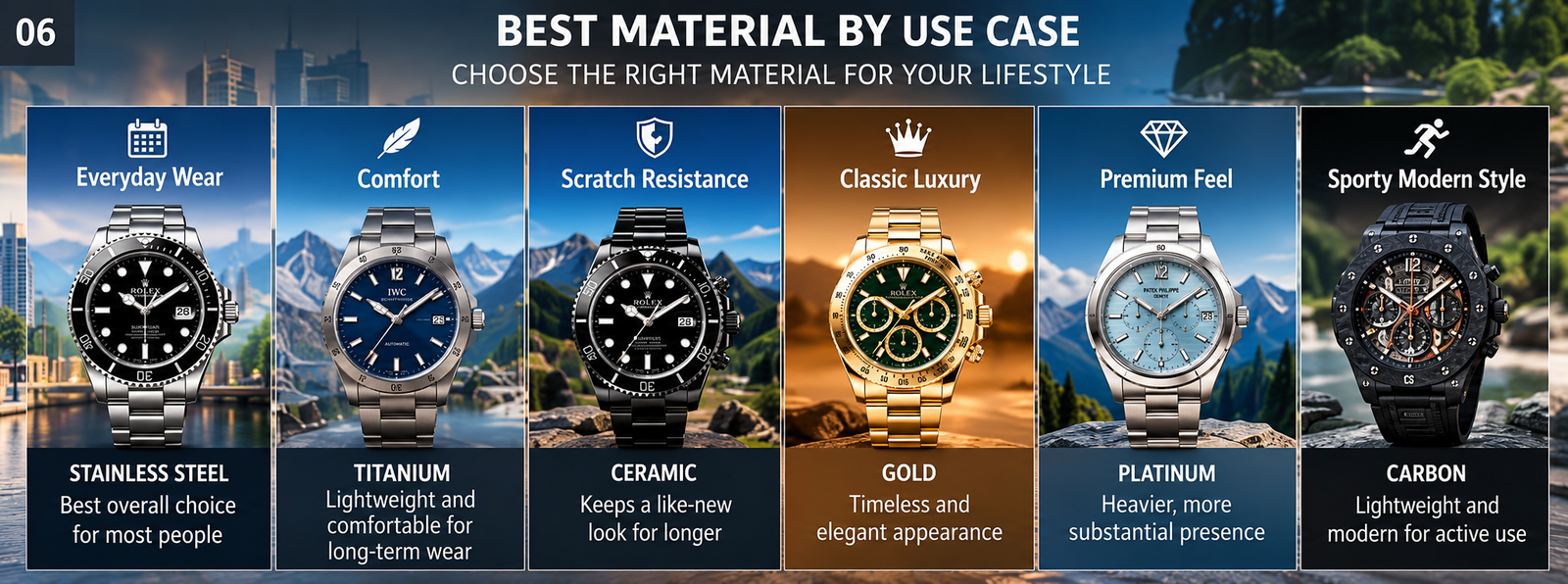
As this luxury watch materials guide shows, trade-offs matter. Pick two priorities—for example, comfort and scratch resistance—then narrow your watch choice accordingly.
Final Visual Comparison
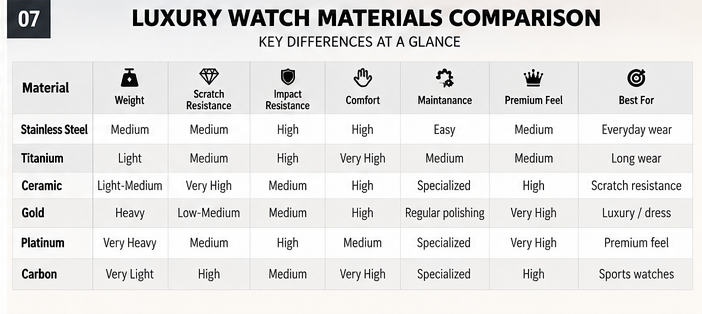
A comparison infographic is useful for narrowing a shortlist, but it cannot replace the specifications of an actual watch.
Different grades, finishing methods and designs can outperform or underperform the broad material categories shown here.
Final Thoughts
Stainless steel is versatile; titanium is light; ceramic is scratch resistant; gold offers warmth; platinum brings impressive heft; carbon provides technical aesthetics.
The most satisfying watch is the one whose design, material, case proportions and maintenance needs match your life.
Use this luxury watch materials guide alongside the Luxury Watch Movement Guide to consider what is inside the watch as carefully as what surrounds it.
For all-round ownership advice, revisit How to Choose a Luxury Watch .
Frequently Asked Questions
What is the best luxury watch material?
Stainless steel is a strong all-round option, but titanium, ceramic and precious metals may be better for specific priorities.
Is titanium better than stainless steel?
It is lighter and corrosion resistant, but scratch behavior and finishing vary. Neither is better for every buyer.
Does ceramic scratch?
Yes, although technical ceramics resist many common scratches. Hard abrasives and impacts can still cause damage.
Is gold too soft for daily wear?
Gold alloys can be used daily, but marks may develop. The alloy, surface finish and careful handling matter.
Why are platinum watches so heavy?
Platinum is a particularly dense precious metal, so equivalent components have greater mass.
Is carbon durable enough for everyday wear?
Well-designed carbon composites can be suitable, but performance depends on construction and resin/fiber formulation.
Which material is best for sweaty or hot weather?
Lightweight titanium or carbon may feel comfortable, but breathability, cleaning and fit are also important.
Which material is best for sensitive skin?
Suitable titanium grades can be useful, while ceramic avoids metal contact at the exposed ceramic surface. Check clasps and casebacks too.
Continue Reading: Luxury Watch Guides
Explore related articles to compare dimensions, movements and pre-purchase checks.
Explore Watch Collections
Compare case styles and finishes. Check the stated composition of each individual product rather than assuming its appearance proves the material.
Submariner Daytona GMT-Master II Datejust